Is Fake AI-Generated Business Photos Secretly Ruining Your Business?
Is Fake AI-Generated Business Photos Secretly Ruining Your Business?
By Vanda Szabo, VS Photography
As a branding photographer and business owner, I’m getting more and more frustrated by the trend of businesses creating fake photographs and videos for their websites, social media and marketing, or manipulating a professional headshot into something that never actually happened.
My aim with this article is to highlight how these fake images and videos can affect trust, your reputation and the message you are sending to potential customers as your customers are buying you and not your AI avatar.
Think about someone visiting your website for the first time. Whatever your profession is, they check you out because they might be considering hiring you. You know the rule: people need to know, like and trust you before buying from you.
Before they have even spoken to you, your photographs are helping them get a sense of who you are. They are curious to see the person they will meet on a call or welcome into their business. They are curious about the person they hope will make their life better with your product or service.
Now imagine they see a beautiful, perfect-looking AI-generated photograph of you in an immaculate office that doesn’t exist, wearing an outfit you have never owned, in a space you have never worked in. It looks professional. It looks polished. It might even look impressive.
But it’s not real. And if you are using that photograph to represent your business without making it clear that it’s AI-generated, what exactly are you telling your potential clients? You are showing them a version of yourself and your business that doesn’t exist.
I completely understand. Creating an AI image can take just a few minutes. You don’t have to organise a photoshoot, spend money on a photographer, outfits, props, etc., or set aside time and energy in your already busy diary.
But with fake images, you can damage your credibility before you’ve even had the chance to build it. If someone meets you in real life or joins a video call and you are noticeably different from the person they’ve seen online, what impression will they get?
We always tend to think we need to look super polished and perfect to impress our ideal client. But let me tell you a secret. Your ideal client doesn’t care whether you have wrinkles, what colour your hair is or how many kilos you are. They only care about how you can help them. How you can make their lives easier and better with your product or service.
Your photographs should help them understand who you are and what it might be like to work with you. They don’t need to be perfect, but they need to be real.
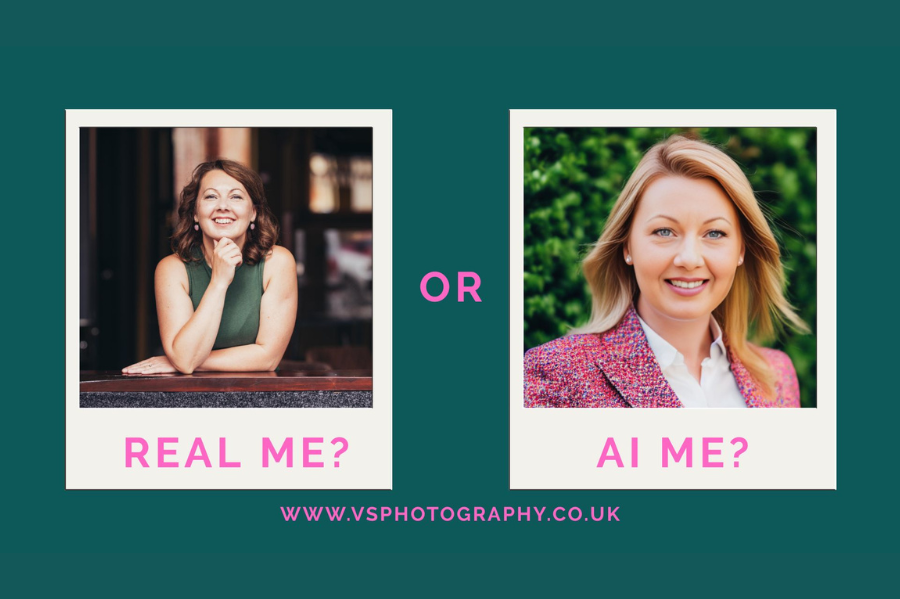
I shared two photographs of myself with this article. One is a real branding photograph captured by a talented photographer. The other is an AI-generated image that doesn’t look like me at all. I look like a person from Corporate America. I look like everyone else. (I have to say that this was generated around four years ago, so obviously, the accuracy has improved a lot since then.)
Some of the AI-generated business imagery I see every day is genuinely bizarre once you look closely.
Healthcare providers using AI images of themselves performing treatments, with tools held incorrectly or equipment that doesn’t make sense.
Fake meetings created by merging people’s headshots into a scene where fake bodies are added and they are hugging or working together, even though they have never met in real life.
And the trend of uploading a perfectly good professional headshot and asking AI to create an entirely new body around it. Suddenly, your head is attached to an outfit, a pose or a body that has nothing to do with you or the original photograph.
Sometimes the results are so surreal that they are almost comical. But in a business context, the consequences can be more serious.
If you are a healthcare professional, your imagery needs to reflect the care and competence people can expect from you. If you are a consultant, it should communicate who you are as a person and the professional your clients will actually work with.
And what about the creatives behind the original photographs?
There is another side to this conversation that matters to me personally, and I’m writing this on behalf of other creatives.
When a photographer creates a branding image, there is far more involved than pressing a button.
We plan the shoot, we consider the lighting, location, composition, styling and purpose of each photograph. We spend years learning and developing our different skillsets to be able to guide our clients, make creative decisions in the moment. We also spend time selecting and editing the final images, as our aim is for your return on investment to come back to you fast.
We are using our experience and creative skills to produce something specifically for our client and their business.
So, when someone takes a professional photograph and uses AI to transform it into something completely different, it can be disheartening. Especially when the original image was created by a photographer they chose, trusted and paid.
And this isn’t just about the money. It’s about seeing your creative work altered and used in a way you may never have agreed to, potentially alongside a message or image that no longer represents your work.
There is also a copyright issue to consider.
Under the Copyright, Designs and Patents Act 1988, copyright in a photograph belongs automatically and exclusively to the photographer the moment the shutter is pressed. This is true regardless of whether a contract was signed, whether the shoot was paid for or whether the subject commissioned the work. There are no exceptions for free or gifted shoots. That means the photographer holds full copyright over all images from our session, including the right to control modifications such as AI manipulation.
So, before uploading a photographer’s work to an AI tool to change it, create new scenes or manipulate the image, please check your agreement and ask the photographer if you are unsure.
It’s a conversation worth having. Creative work deserves to be treated with respect.
I’m not against AI. I’m against losing sight of what makes us human.
AI is here, and it is a useful tool. I asked AI to help me grammatically correct this article as English is not my mother language. I’m not suggesting we should reject every new technology or that businesses must only ever use traditional photography. I’m suggesting perhaps we need to stop accepting AI slop as a substitute for genuine human creativity, experience and connection.
Maybe today, put yourself in the shoes of your ideal customer and think about what they need to see about you to know, like and trust you.
Join me in November, when I’m going to talk about this topic as the guest expert at the Worcester group.
In the meantime, if you would like real business photos, feel free to drop me an email at .
Share this article
Follow us
Latest articles
October 24, 2026
October 24, 2026